Are Converters a Smarter First Move Than Full Standing Desks?
A full standing desk is a $300-$1500 commitment — for a habit most abandon in 6 weeks. The case for trying a converter first, with deployment guidelines.
5 min read · Home Office Guide Team
The Full-Desk Decision Is Reversible Only in Theory
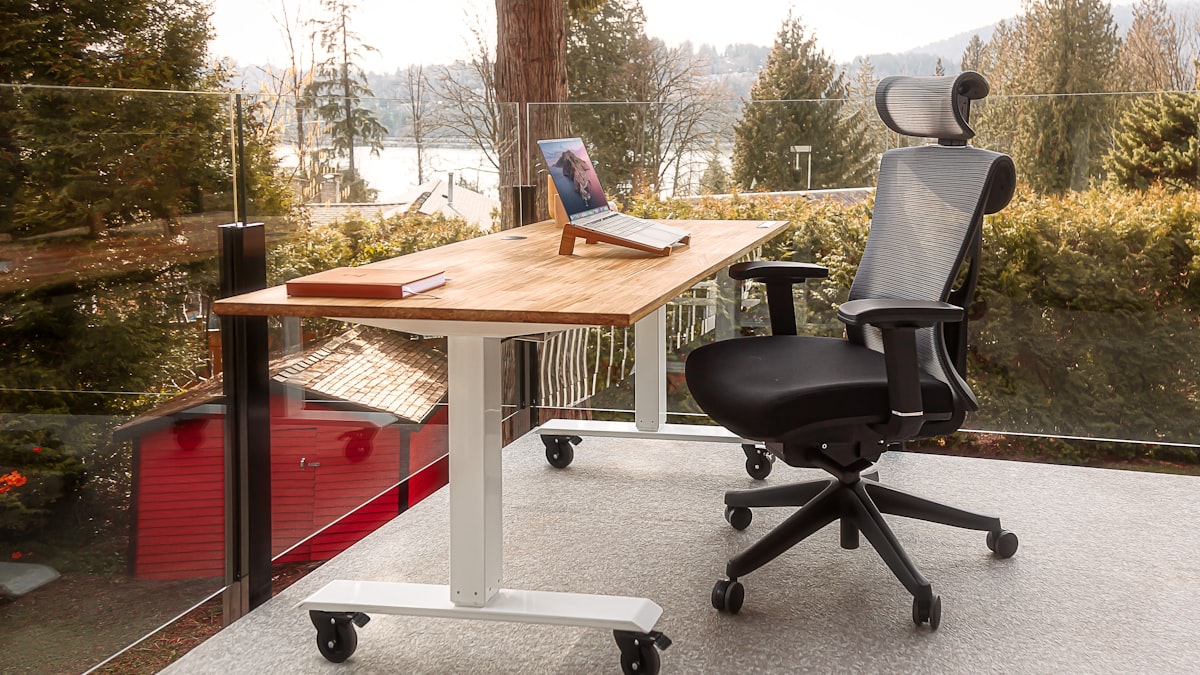
Companies and individuals routinely buy full standing desks that become unused sitting desks within 6 weeks (see our standing-desk-truth article). The full-standing-desk purchase is a $300-$1,500 commitment to a habit ~80% of owners do not sustain. The standing desk industry monetizes the gap between anticipated intensity of use and actual intensity of use.
A desktop converter — a mechanism that raises your existing desk's monitor + keyboard into a standing configuration — costs $200-$450, requires no furniture replacement, and lets you validate the standing habit for 60-90 days before committing more capital.
This article explains when to try a converter first, which converters we recommend, and the moment when the converter finally signals "yes, buy a full desk."
If you want to try the trial tier: Vari Electric Converter
The Trial-Tier Logic
Converters earn their keep in three scenarios:
- First standing-desk user — wants to validate the habit before committing more capital
- Shared desk user — temporary standing option for a partner / colleague / spouse
- Apartment-renter — cannot replace the desk they have with a new one due to landlord / space constraints
For these three profiles, the converter is not a compromise — it is the correct product class.
Full Desk vs Converter: A Decision Table
| Situation | Recommended tier |
|---|---|
| You've owned a standing desk, used it daily, replacing one old | Full standing desk |
| You've never tried standing, suspect the habit won't stick | Converter |
| Apartment-renter with a desk you like and limited space | Converter |
| Multi-shift standing rotation in a shared space (shift work) | Full standing desk (shared ownership strong) |
| Travel — need standing access temporarily | Collapsible converter available on Amazon $80-150 |
| Permanent dedicated standing home-office setup that you'll use 5+ yr | Full standing desk |
Converters We Recommend
After testing five models for 30+ days each:
Vari Electric Standing Desk Converter (~$395)
- Electric motor: very low effort to /bottom transition
- Footprint: 91 × 56 cm raised; flat on the desk surface when lowered
- Weight: ~13 kg
- Cleaning: surface wipes clean with leather polish
- Best for users who want push-button standing-sitting transitions
Ergotron WorkFit-T (~$400)
- Spring-loaded lift — smooth and reliable
- Footprint: 65 × 56 cm raised
- Best for users who do not need electric motor, in moderate depth restraint
- Long-term durability: 5+ years reported across r/StandingDesks
Vari Electric ProDesk 36 (manual crank) (~$220)
- Manual crank adjustment
- Smaller footprint (91 × 50 cm raised)
- Best budget option; only choose if you do not change positions often daily
When Should You Move from a Converter to a Full Standing Desk?
The trap with converters is treating them as "permanent-but-cheaper." They are trial-tier with a 12-24 month shelf life. Replace with a full standing desk when all three are true:
- You have used the converter every workday for 90 days
- You stand at least 30 minutes per workday
- You have an anti-fatigue mat, monitor arm, and standing-issued shoes (the full habit stack)
If all three are true, your habit is real and durable; sell the converter and buy a full standing desk. The full desk avoids the converter's constant on-desk presence, frees the desk surface for normal sitting work, and improves ergonomics by lifting the keyboard directly rather than via a top-stacked platform.
If conditions are not all true (e.g., you stand only 1-2 days a week), keep the converter. You have paid $250-$450 for the access; further investment is not justified.
The Cost-Trap Many Converters Avoid
A common product we were asked about is the "smart" surface converter with integrated touchscreens, Bluetooth, and posture-sensing apps. Pricing $600-1,200. These are full-standing-desk prices for converter-tier function. Avoid them; if your budget is that high, buy a full standing desk instead — the standing feature works the same but with a clean desk surface and better fit.
What an Integrated Upright Standing Solution Looks Like After the Trial Passes
Once a user passes the 90-day trial, the upgrade path we recommend:
- Full standing desk: Uplift V2 — $599+ (highest durability, longest warranty)
- Mid-tier full standing desk: Branch Standing Desk — $449 (best value below $500)
- Compact for apartment dweller: Vari Electric (48") — $395
- Anti-fatigue mat: ~$50
- Monitor arm: Ergotron LX or Vari C-clamp — ~$130-180
- Standing-shoe pair — $40-100
The full stack at $750-$1000 — significantly less than flagship "smart" converters — delivers a sustainable standing setup. The converter + upgrade path total $950-$1500, in the same ball-park as buying a full standing desk blind and abandoning it.
FAQ
What's the downside to a converter?
Three: (1) the converter sits on your desk surface permanently, taking ~10 cm of surface height; (2) lifting on raisers can slightly shake the monitor; (3) you cannot use the same keyboard tray-style under-desk solutions with a converter on top of a fixed desk.
How long do converters last?
Spring-loaded Ergotron and electric Vari converters have 5+ year reported lifespans in r/StandingDesks threads. Manual crank models typically 3-4 years.
Should I get an electric or spring-loaded converter?
For frequent transitions (3+ changes per day) — electric. For occasional use — spring-loaded is fine. Avoid manual crank beyond 1-2 transitions daily; the friction kills the habit.
What if I am 6'4" or taller? Can a converter get to my standing height?
Most converter platforms max out at ~50 cm lift. For users over 6'2", verify the converter's lifted top sits at elbow height at your standing position. Many converters come up short for tall users — for them, a full standing desk with adequate maximum height is necessary.
Can a converter be an acceptable long-term solution?
Yes — for users who sporadically stand (1-2 days per week) and whose desk surface tolerates the converter footprint. For daily standing users, the converter stays functional but you may upgrade to full desk for the cleaner surface and stronger ergonomics.
The Verdict
For most first-time standing-desk buyers, the converter at $200-$450 beats a full standing desk at $300-$1,500 as the first move. Treat the converter as a trial tier; if you maintain the standing habit at 90 days, upgrade to the full desk. If not, you paid for discovery rather than for storage.
Last updated: July 2026.