Standing Desks for Small Apartments: What Actually Fits
Standard standing desk guides assume you have room. This reverse-fits desks to 8-12 m² rooms — depth, footprint, footprint alternatives, and converter options that genuinely fit small apartments.
5 min read · Home Office Guide Team
"Does It Fit" Beats "Best Standing Desk"
Almost every "best standing desk" guide assumes the reader has a dedicated home-office room and 1.5 × 0.8 m of floor area. For apartment dwellers in 8-12 m² studios, one-bedrooms with shared living space, or anyone whose office doubles as a bedroom, "best" is irrelevant. What actually fits is the only question.
This article is the standing desk buyer's guide for small apartments — three configuration patterns that genuinely work, plus the dimensions and products that define each one.
For the most compact option we tested: Vari Electric Standing Desk → 48" wide
Three Configuration Patterns That Actually Work
| Pattern | Floor area required | Cost tier | Best for |
|---|---|---|---|
| 1. Compact electric standing desk (120 x 60 cm) | ~1.0 m × 0.8 m | $350-600 | Permanent dedicated-standing setup |
| 2. Desktop converter on existing desk | Starts at 0 added floor space | $200-450 | Hybrid trial; unsure if permanent standing |
| 3. Wall-mounted folding standing desk | folds flat when not in use | $250-500 | Multi-purpose space (desk folds to 8 cm depth) |
Pattern 1: Compact Electric Standing Desk (120 × 60 cm)
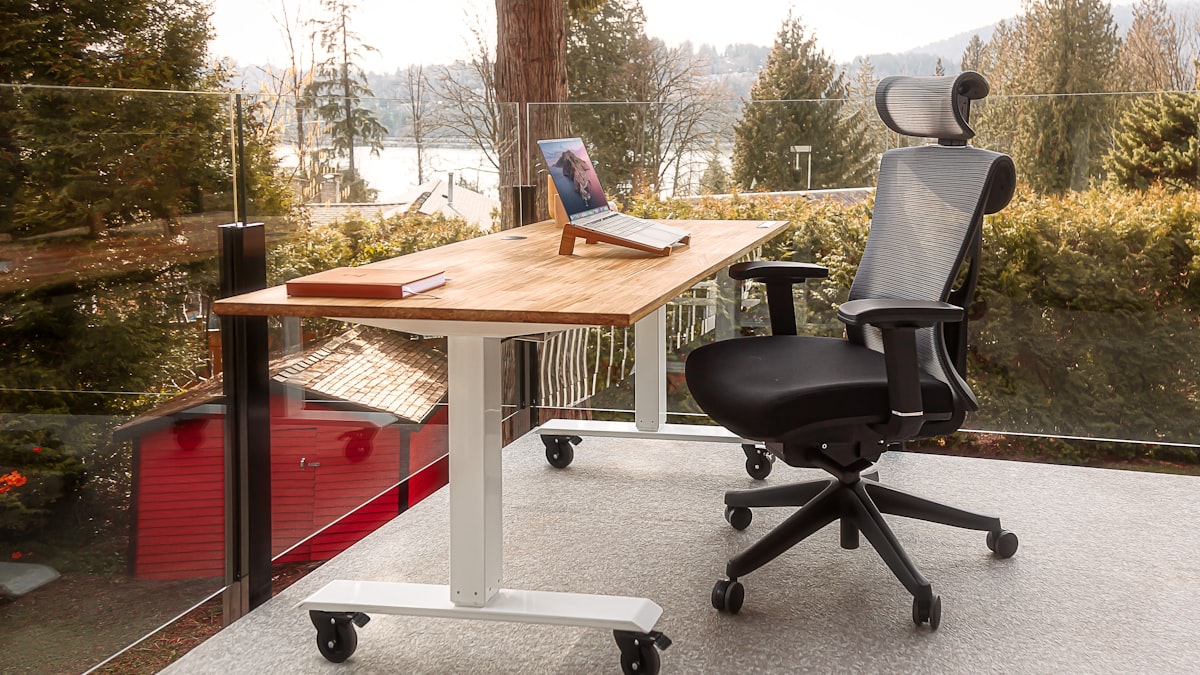
The minimum standing-desk footprint that is comfortable for sustained work. Width 120 cm (47 inches) fits a single monitor + laptop + mouse; depth 60 cm is the minimum viable (see our back-pain guide on desk depth). Add ~30 cm of chair clearance depth behind the desk.
Total floor area: ~1.0 m × 0.8 m (or 0.8 m²).
Best picks we tested:
- Vari Electric Standing Desk (48") — $395; ships pre-assembled, ~5-min setup. Best value compact full standing desk. Width 122 cm × depth 65 cm.
- Branch Standing Desk — $449; furniture-grade finish. Width 120 cm × 60 cm. Most attractive for shared-space living.
- Uplift V2 with 48"-wide top — $599+; longest warranty (15 years). Width 122 cm × 65 cm.
The Uplift is the most durable; the Branch is the most attractive for living spaces; the Vari is the easiest to set up.
Pattern 2: Desktop Converter (No Added Footprint)
A converter sits on an existing desk and raises monitor + keyboard. No new floor space required — the same desk now does both sitting and standing. Trade-off: more visible clutter than a full standing desk.
Best picks:
- Vari Electric Standing Desk Converter — $395; cleanest mechanical footprint, electric-assisted.
- Ergotron WorkFit-T — $400; the best-engineered converter we tested. Lifts with a single motion.
- For budget: manual-crank models at $180-220 work fine if you only stand/sit transition a few times daily.
This pattern is correct for apartment dwellers who already have a desk they like and want standing access without a footprint expansion.
Pattern 3: Wall-Mounted Folding Standing Desk
The least-discussed option but the one apartment dwellers in r/StandingDesks threads consistently praise. The desk folds flat against the wall (≤ 8 cm depth) when not in use, freeing the entire floor area.
Picks:
- Bysen Foldable Standing Desk — ~$300; electric lift, folds flat. The category leader for true space-max.
- IKEA wall-mounted standing desk hacks — DIY combinations from IKEA BEKANT + LAGKAPTEN; budget route ~$250.
Trade-off: the wall mount requires drilling and a sturdy stud wall; renters should check with landlord first. The folding/ unfolding habit takes longer than the surface gain — your standing-sitting transitions slow by 30-60 seconds.
The Depth Trap Most Apartment Buyers Hit
Even within the 120 × 60 cm size class, depth is the friction variable. Standard standing desks ship 65-72 cm deep, which in a 3 m-deep studio bedroom wall immediately eats a third of the work space from a single wall. Two adjustments:
- Pick a desk at 60 cm depth maximum (Branch model; or Uplift V2 with the 60 cm top option)
- Mount the monitor on a wall or a clamp desk arm — eliminates 15-20 cm of monitor footprint and gives you back depth for keyboard forearms
The Footprint Reduction Hierarchy (Optional)
If your apartment truly cannot afford even a 120 × 60 cm footprint:
- Use a Autonomous SmartDesk Go compact frame (100 × 60 cm) — saves 0.1 m²
- Pair with a foldaway chair (OmniMount OmniStand or eq.)
- Wall-mount the monitor with a foldable arm — eliminates 15 cm of desk depth
- Fold-away keyboard tray — clears surface clutter when not in use
Total: ~0.6 m² footprint, can work in a 6 m² room.
FAQ
Will a small standing desk still be comfortable for hours of work?
Yes, with the depth-correct top and a clamp monitor arm. Most standing-desk discomfort in small apartments is from desks that are deep enough to read luxurious but shallow enough to cramp the forearms. Pick 60 cm depth quality, not 80 cm depth as a default.
Should I pick a converter or a full standing desk in a small apartment?
If the existing surface desk is good and your desk will be visible in a living area, converter — unless you are sure you will use the standing feature daily. If you have no desk and need to add one, full compact standing desk — the surface area is not wasted on a converter add-on.
Can a wall-mounted folding standing desk actually hold dual monitors?
Up to ~15 kg (depending on model). A single curved ultrawide is more apartment-friendly than dual monitors. Many wall-mount models will support a single monitor + laptop.
What about a corner L-shaped standing desk?
Most L-shaped standing desks assume a permanent corner corner, and most small apartments cannot spare a full corner. The Autonomous L-Shaped SmartDesk (~$700) is the L-shape option if the corner is non-negotiable. We recommend single-surface 120 × 60 cm over L-shaped for a small apartment unless the corner is genuinely free.
Where do I put the chair when I am standing?
A foldaway chair (IKEA NORBERGET, OmniMount OmniStand) fits under the desk or hangs on the wall. Converters and full standing desks often leave a chair-shaped gap during standing; foldaway closes the loop.
The Verdict
For small apartments, "best standing desk" is meaningless; "what actually fits" is the real question. Choose Pattern 1 (compact full electric) for permanence, Pattern 2 (converter) for validation, Pattern 3 (wall-mounted folding) for multi-purpose space. The product that fits the room beats the product with the highest rating.
Last updated: July 2026.